Written By: Britt L. Brown LMT, Founder of Well-Go tiny spa
Hello fellow foragers and foragers to be! Are you enjoying the bounty of this year’s Fall mushroom foraging season? I know I am! I’m especially excited about all of the tasty Cantharellus formosus, also known as “Pacific Golden Chanterelles”, that I’ve been able to forage. They are one of my favorite culinary mushrooms growing here in the Willamette Valley, and they just so happen to be the state mushroom here in Oregon! Packed full of vitamins and nutrients, Cantharellus formosus are great for your gut health, and I have a variety of recipes I love to add them to as well. Interested in knowing more? Awesome, let’s get friendly with this tasty fungi!
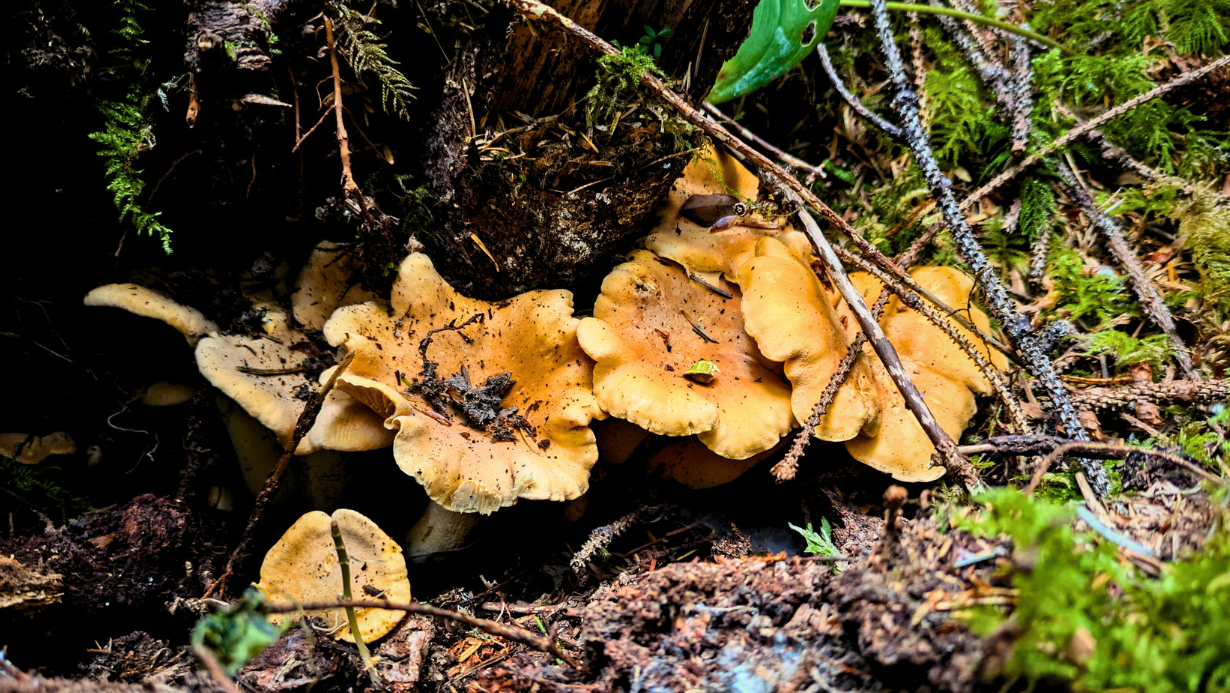
As a general description – Cantharellus formosus have a somewhat golden color to the outside of their flesh, similar to the color of apricots or the peel of pink grapefruit, but on the inside their flesh tends to be white or pale-apricot in color. The mushroom cap can be anywhere between 3cm – 10cm in diameter with an irregular and/or wavy margin and will either be flat, slightly depressed in the center, or convex in shape, and have false gills under their cap. The stipe (stem) of the mushroom can be torn/peeled similarly to string cheese, and has a nice meaty texture when chopped for ingredients like soup or to saute. Cantharellus formosus have a sweet earthy aroma to them when freshly harvested, and add a nutty umami flavor to soups that I am obsessed with!
Cantharellus formosus are found most abundantly here in Oregon – particularly along the Coastal Cascade Range – but they are also found along that same mountain range throughout California and Washington. To find them you’ll want to keep your eyes out for a few key environmental factors while you’re out foraging and frollicking through the forest:
- Dead and dying conifer trees – Chanterelles in general love to grow around the base of dead and dying conifer trees such as Western Hemlock, Douglas Fir, and Spruce trees. This is because they have a symbiotic mycorrhizal relationship with the roots of conifer trees!
- Fall is in the air – The growing season for Cantharellus formosus here in Oregon can start as early as the last week or two (2) of August and will generally continue until the first frost hits the area.
- Favored foliage and detritus – Chanterelles can often be found hiding beneath ferns, tucked between branches of Oregon Grape, and peeking out from under the moss on the forest floor.

Now… that might seem like a pretty distinct description, especially to those readers who are new to mushroom foraging in particular, but there are some sneaky look-alike fungi out there that aren’t as friendly as Cantharellus formosus, and those fungi are:
- Omphalotus olivascens – Or the “Western Jack O’ Lantern” fungus is often mistaken for chanterelles in its earlier stages of growth, because the colors can look similar to the untrained eye, and they tend to grow in similar environments. Some key identifiers though are that “Jack O’ Lantern” fungi tend to grow in large clusters, and they have true gills rather than the false gills that are found on chanterelles like Cantharellus formosus (see photo). Not a snack.
- Hygrophoropsis aurantiaca – Commonly referred to as the “False Chanterelle”, Hygrophoropsis aurantiaca is anything but friendly when it comes to edibility. Eating this particular fungi will most certainly lead to gastric distress. Thankfully this mushroom also has a couple of key identifiers, one being that it also has true gills rather than false gills, the other being that it tastes horribly bitter when doing the “spit test”. Not a snack.
- Turbinellus floccosus – Also known as the “Scaly Vase Chanterelle” and the “Wooly Chanterelle” this unfriendly fungi have been known to give those who eat them horrible diarrhea a couple of hours after they’ve been consumed, earning them a third common name – “bed pooper chanterelles”! Turbinellus floccosus looks really convincing from a distance, but it’s the “scaly” or “wooly” texture to the cap and the extra wrinkly texture to their false gills that give them away once you get up close. Not a snack.


Once we’ve successfully foraged (or purchased, no shame) our delicious golden mushroom-y treasures, it’ll be time to start finding tasty recipes to put them in – woohoo! Before we do that though, let’s go over the key things to remember when preparing our Cantharellus formosus for edibility… because the last thing we want to experience after a successful day in the woods is a gut-wrenching evening on the toilet!
- Rinse before eating – I know a lot of folks out there grew up around the concept of “God made dirt, and dirt don’t hurt” but please hear me when I say – that is most certainly not the case. There are all kinds of microbes living in the soil, depending on where you foraged your finds there could be pesticides, hell… someone could have peed on that mushroom while out frollicking in the forest earlier in the day – you never know! The point is, rinse what you forage before you go to eat and/or cook it
- Cook thoroughly – While some mushrooms are perfectly safe to consume raw, Cantharellus formosus should be thoroughly cooked to prevent gastric upset which can occur if you’re sensitive to chitin (which gives mushrooms their unique fleshy texture). Personally, I prefer the flavor and mouthfeel of cooked chanterelles myself, and below are my two favorite ways to prepare them.
- Sauté – Tossing your chopped (or whole if you prefer) chanterelles in a cast iron skillet to let all of the excess moisture cook out of them, then continue sautéing them with some butter, minced garlic, pepper, salt, and a little fresh rosemary? Absolutely delish – and best of all you can then add your mushrooms to nearly any dish to give it that pop of umami! I love putting sautéed chanterelles in my egg scrambles for breakfast and sprinkle them into my tomato soup for lunch.
- Dehydrate and Powder – I am currently blessed to have a partner who both loves to forage with me and has their own dehydrator, and I have loved dehydrating and powdering my chanterelles as a way to keep that delicious Fall mushroom flavor in my life all year long!
- Don’t overdo it – When we’re excited to try something new, it’s easy to get caught up in said excitement, and forget that we’re possibly introducing our bodies to something they’ve never had to process before, and it’s important to remember that our bodies don’t always react kindly to new things – especially foreign foods. While some folks out there are blessed with a dwarven constitution, many of us tend to experience gastric upset of some kind if we introduce our body to too much of a new thing, or to too many new things at once. So before we dive into a recipe that has Cantharellus formosus as the star of the dish, we might want to try it as a tasty topping on something our bodies are more familiar with.
Alright – we’ve foraged our mushrooms, we’ve cleaned our mushrooms, and we’ve prep’ed our mushrooms, and best of all – we didn’t end up in the hospital! Now we’re ready to start finding tasty ways to add them into our diet and reap their delicious nutritious benefits, and what better way to start by sharing some recipes?

Chanterelle Mushroom Gravy (click here for recipe) – I love this recipe for its simplicity and the fact that it is a fantastic batch cook item. Typically for my recipe I’ll replace the traditional flour with a gluten-free flour, I’ll sub the turkey stock for chicken stock, and the white pepper for black pepper – and that’s all just because of my personal preferences. Personally, I find that this recipe really shines brightest when poured over some fresh and flaky buttermilk biscuits for breakfast.

Sautéed Chanterelles (click here for recipe) – There isn’t much that you can’t do with Sautéed Chanterelles; they’re delicious as a savory side to a turkey dinner, they’re amazing when stuffed in hand pies, and who doesn’t love sautéed foraged wild mushrooms in stir fry?! For this recipe I like to sub the thyme for rosemary, and I tend to prefer my garlic minced as opposed to sliced, but man oh man… this dish is delish and versatile!
Regardless of how you choose to incorporate more Cantharellus formosus in your diet, you can expect to also enjoy the following health benefits as well…
Reduced inflammation – If you live with a chronic illness or an inflammatory condition such as arthritis or inflammatory bowel disease, adding Cantharellus formosus to your diet could reduce the overall inflammation you experience in your body. This is due largely to the fact that they are rich in antioxidants and other bioavailable compounds like ergothioneine and ergosterol, both of which provide pain relief and reduce swelling related to inflammatory conditions.
Improved Immunity – In addition to the antioxidants and the other bioavailable compounds listed above, Cantharellus formosus are rich in vitamins and minerals, and they contain polysaccharides and beta-glucans – compounds known to help boost and enhance the immune system. Some research suggests that they may even possess antiviral and antimicrobial properties, as well as potential cancer-fighting properties. Chanterelles are also one of the few foods containing vitamin D, an essential vitamin to maintaining a healthy immune system, digestive system, and nervous system function.
As a Licensed Massage Therapist, I feel like I could build a second career out of recommending anti-inflammatory foods to my community. So many of the chronic illnesses and diseases we all struggle with are either attributed to or made worse by chronic inflammation. Many of us also struggle with chronic muscle pain and hypertonicity which is absolutely exacerbated by, and associated with, chronic inflammation. There are so many delicious foods out there to help us mitigate those symptoms, our fungi friend Cantharellus formosus is just one of them!
To learn more about Cantharellus formosus and all of their amazing health and dietary benefits, take a look at the articles I’ve cited below, and feel free to share your own tasty fungi friendly recipes in the comments, I’d love to hear more about them! I’ve also left links to various foraging social media groups for those of you hoping to connect to local experts where you live, and to help you identify all of the friendly fungi you might find out there in the wild.
Cited Sources:
- Oregon Discovery, “Pacific Golden Chanterelle – Oregon State Mushroom”, 10/29/2024. WEB. https://oregondiscovery.com/pacific-golden-chanterelle
- Kuo, M. (2019, November). Cantharellus formosus. Retrieved from the MushroomExpert.com Website: http://www.mushroomexpert.com/cantharellus_formosus.html
- Baer, Dale. “Chanterelle Mushrooms”. Oregon Encyclopedia, Oregon Historical Society. Online Article written March 13th, 2023. Viewed Online: 10/30/2024. WEB: https://www.oregonencyclopedia.org/articles/mushroomschanterelles/
- Ajmera, Rachael MS, RD. “Chanterelle Mushrooms: Nutrients, Benefits, and Recipe”. Healthline Magazine. Online Article written April 22nd, 2022. Viewed Online: 10/20/2024. WEB: https://www.healthline.com/nutrition/chanterelle-mushrooms
Social Media Foraging Communities:
- Mushroom Lovers (ID, Foraging, and Growing) on Facebook
- Fungi of the World on Facebook
- Pacific Northwest Mushroom Identification Forum on Facebook
- Oregon Mycological Society on Facebook
- Edelic Center for Ethnobotanical Services

about the blogger…
Hey there! My name is Britt, I’ve been working in the lovely state of Oregon as a Licensed Massage Therapist since 2008, and I want to share my knowledge and experience with you! Follow my blog to find awesome self-care tips and learn how you can bring spa-level luxe into your daily routine. Do you have questions about massage therapy, self-care, or about how to book Well-Go tiny spa services for your next event? Be sure to write me an email or leave a comment!

Leave a Reply